


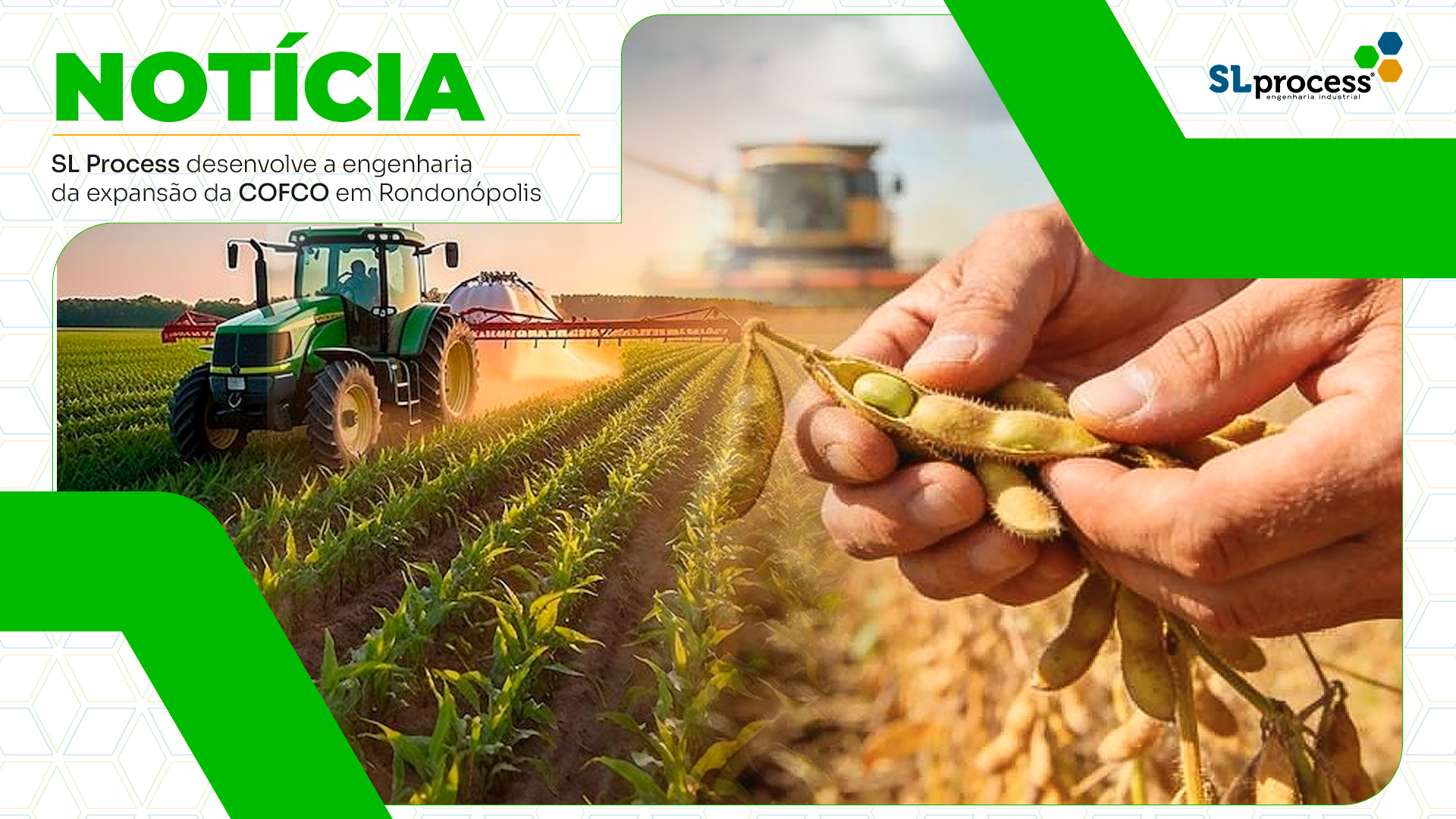
COFCO International announced an investment exceeding R$ 2 billion to expand its soybean processing unit in Rondonópolis, Mato Grosso.
The project aims to increase the plant's crushing capacity from the current 4,500 tons to approximately 10,000 tons of soybeans per day. According to the Rondonópolis City Hall, with the expansion, the unit should become the largest soybean crushing complex in Brazil. The completion of the works is scheduled for early 2028.
A SL Process is developing the engineering for this project, contributing technically to one of the most significant agro-industrial expansions recently announced in the country.
This participation reinforces SL Process's presence in large-scale projects and the confidence of major agribusiness players in its ability to develop integrated industrial engineering solutions.
What was announced by COFCO
The COFCO plant is located next to the Rondonópolis railway terminal and currently produces soybean meal, soybean oil, and biodiesel.
With the announced investment, processing capacity is expected to increase from 4,500 to approximately 10,000 tons per day. The expansion will allow for increased production of higher value-added byproducts, especially soybean meal and oil.
The published forecast presents the following key data:
| Indicator | Current situation | After the expansion |
| crushing capacity | 4,500 tons per day | Approximately 10,000 tons per day |
| Products from the unit | Soybean meal, soybean oil and biodiesel | Expanding the range of processed products |
| Investment announced | More than R$ 2 billion | |
| Expected completion | Beginning of 2028 |
According to the information released, the expansion will be carried out at the existing unit, characterizing an industrial project that needs to integrate new structures, systems, and capabilities into the already installed operation.
What does soybean crushing mean?
Crushing is the industrial step responsible for transforming soybeans into higher value-added products.
During this process, the soybeans go through stages of receiving, preparation, conditioning, extraction, and separation. The main resulting products are soybean meal and soybean oil.
The bran is mainly used in the formulation of feed for poultry, swine, cattle, and other animal production chains. The oil can be directed to the food industry, various industrial applications, and biodiesel production.
At the Rondonópolis plant, the integration between soybean processing, oil production, and biodiesel manufacturing allows different stages of the agro-industrial chain to be connected within the same complex. The plant's current structure already includes the production of soybean meal, soybean oil, and biodiesel.
Expanding capacity therefore represents more than just increasing the volume of raw materials received. It involves growth in internal handling, processing, storage, utilities, logistics, automation, security, and shipping of finished products.
Why is this investment relevant to agribusiness?
Brazil has a significant soybean production, but the development of the supply chain does not depend solely on the volume harvested.
To add value to the grain, investments are needed in receiving, storage, handling, processing, production of by-products, and logistics.
The expansion of the Rondonópolis unit increases the processing capacity for soybeans within an important producing region. Instead of only handling the grain, the industrial operation generates meal, oil, and biofuel, products that serve different markets and production chains.
The plant's location next to a railway terminal also represents a logistical advantage. It is reasonable to infer that this connection could contribute to the movement of raw materials and products on a larger scale, although the logistical details of the project have not been publicly disclosed.
The project is also expected to generate new jobs and increase demand for suppliers, service providers, and specialized professionals during the engineering, implementation, and operation phases. The Rondonópolis City Hall highlighted the expectation of job creation and strengthening of the local economy.
Rondonópolis expands its presence in the agribusiness sector.
Rondonópolis occupies a strategic position in the agribusiness chain of Mato Grosso.
The municipality brings together agricultural production, storage facilities, processing units, transport companies, service providers, and rail connections. The municipal administration classifies the city as one of the main economies of the state and highlights its importance in Mato Grosso's exports.
The new expansion is taking place in a context of attracting large industrial investments to the municipality.
For the regional supply chain, increased processing capacity can expand demand for soybeans, logistics services, industrial maintenance, equipment supply, assembly, automation, safety, and various engineering specialties.
This movement reinforces the transformation of grain-producing regions into industrial hubs capable of locally processing a larger share of agricultural production.
SL Process's role in the project
SL Process is developing the engineering for the expansion of COFCO's unit in Rondonópolis.
Projects of this scale require integration between different technical areas, as well as compatibility between the new facilities and an existing industrial infrastructure.
SL Process's work in industrial engineering encompasses disciplines such as civil, mechanical, process, piping, electrical, instrumentation, automation, architecture, and infrastructure. The company also utilizes integrated BIM solutions to connect design, planning, and execution with greater precision.
The goal of engineering is to transform expansion needs into documents, models, and specifications capable of guiding the next stages of the project.
This involves evaluating interfaces, capabilities, equipment, structures, utilities, electrical systems, automation, security, access, and operational needs.
The contractual details and specific scope developed by SL Process are not presented in this article. The company's participation is communicated in an institutional manner, respecting the authorized information about the project.
Get to know the SL Process industrial engineering solutions.
The challenges of expanding an existing industrial unit.
An industrial expansion presents different challenges than building an entirely new plant.
The new structure needs to be integrated with existing systems, taking into account the actual conditions of the unit, the physical boundaries of the land, interferences between disciplines, and the continuity of operations.
In projects of this type, engineering needs to assess issues such as:
Integration with the existing plant
New equipment and infrastructure need to connect to existing systems without creating physical or operational conflicts.
Increased utility capacity
Steam, water, electricity, compressed air, thermal systems, and other utilities may need to be expanded to meet the new production capacity.
Movement of raw materials and products.
Increased processing requires a thorough analysis of receiving, transportation, storage, and shipping systems.
Industrial safety
The expansion must take into account fire prevention and control measures, pedestrian circulation, emergency access, process risks, and compliance with applicable regulations.
Implementation planning
The stages of the project need to be organized to reduce interference with existing operations and ensure greater predictability in the schedule.
A SL Process works on industrial expansion, modernization, and adaptation projects., connecting engineering, safety, planning and operational reality.
Multidisciplinary engineering for soybean processing
A soybean crushing unit brings together different industrial systems within a single operation.
The process begins with receiving and storing the grain. Next, the soybeans go through cleaning, preparation, and processing systems. After extraction, the meal and oil proceed to further stages of treatment, storage, or shipping.
Each of these areas needs to be connected to the supporting disciplines.
Civil engineering develops foundations, buildings, structures, access, and infrastructure. Mechanical engineering focuses on the definition and integration of equipment. Process engineering organizes flows, capacities, and operating conditions. Electrical and automation engineering provide power, control, and monitoring for the plant.
Piping, utilities, security systems, and planning also need to be developed in a compatible manner.
Integrating these specialties reduces interference, improves the quality of information, and contributes to a more predictable deployment.
Learn about SL Process's performance in projects for the extraction and processing of vegetable oils.
The importance of BIM in large-scale projects.
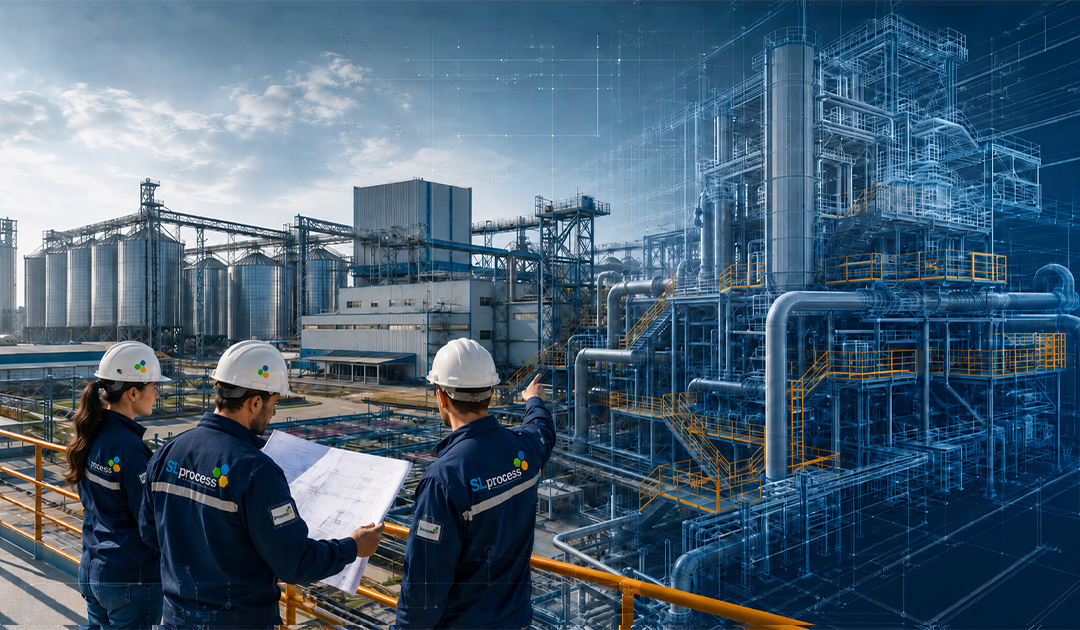
The BIM methodology allows different disciplines to be brought together in integrated digital models.
In an industrial expansion, this integration helps to identify conflicts between structures, equipment, piping, electrical installations, and other systems before these interferences reach the field.
SL Process uses tools such as Revit, Plant 3D, Civil 3D, Navisworks, and Autodesk Construction Cloud to connect engineering, compatibility, and execution.
In projects with a high number of interfaces, integrated modeling contributes to:
To reconcile the technical disciplines
Identify interferences before assembly.
Improve the visibility of the project.
Support the planning of the implementation phases.
To improve the quality of information used in the field.
Reduce late adjustments and rework.
Technology, however, does not replace engineering knowledge. It organizes and expands the analytical capacity of the teams responsible for the project.
A relationship built with COFCO
COFCO is already part of SL Process's public client portfolio.
The projects page of grain storage It presents work developed for COFCO units in Carlinda and Marcelândia, in Mato Grosso.
Participation in the expansion of Rondonópolis broadens this trajectory and reinforces a relationship based on technical trust, knowledge of the agro-industrial sector, and the ability to serve projects in different regions.
For SL Process, being involved in an investment of this magnitude represents the continuation of work developed with one of the largest global agribusiness organizations.
Who is COFCO International?
COFCO International is a global agribusiness platform belonging to COFCO Corporation.
According to institutional data published by the company, it has more than 12,000 employees in 35 countries, moves approximately 100.4 million tons of products, and maintains commercial relationships with more than 50 countries. Its operations include grains, oilseeds, sugar, coffee, cotton, processing, and logistics.
The presence of a company of this scale in expansion projects in Brazil highlights the country's strategic importance for the global supply and processing of agricultural products.
For SL Process, developing engineering for a player of this size reinforces its ability to work on industrial projects that require a multidisciplinary structure, technical rigor, and integration between different areas.
SL Process's presence in major projects.
Founded in 2003, SL Process originated in the agro-industrial sector and currently develops projects for different industry segments.
The company operates throughout Brazil and also in Latin America, connecting studies, engineering, supplies, and deployment management.
Their portfolio includes projects in grain storage, biofuels, biooils, fertilizers, energy, and the food industry.
In the storage sector, the projects presented by the company total 2.5 million tons of capacity. The portfolio includes projects developed for large industrial and agro-industrial groups in different Brazilian states.
This experience allows the company to participate in complex projects with a vision that considers process, operation, infrastructure, safety, cost, timeline, and implementation.
Learn more about SL Process trajectory and the customers who trust our solutions.
Engineering as a basis for major investments
Large-scale industrial investments begin long before construction starts.
They depend on the definition of premises, capabilities, processes, interfaces, equipment, auxiliary systems, and deployment strategies.
The larger the scale of the undertaking, the greater the need to integrate technical information and anticipate decisions.
A well-structured engineering process helps reduce uncertainty, improve the quality of contracts, organize planning, and prepare the project for real-world execution conditions.
In the investment announced by COFCO in Rondonópolis, the expansion of capacity represents a technical challenge directly connected to the growth of Brazilian agribusiness.
For SL Process, participating in this project reinforces its presence among major players and its ability to transform expansion objectives into industrial solutions developed with precision, integration, and technical responsibility.
About SL Process
A SL Process It is an industrial engineering company founded in 2003.
Based in Florianópolis, Santa Catarina, the company operates throughout Brazil and in other Latin American countries, developing solutions from initial studies to implementation management.
Its structure brings together professionals and disciplines focused on the development of complete industrial projects, serving segments such as grain storage, vegetable oil processing, biofuels, fertilizers, energy, and food.
To discuss industrial expansion, modernization, or implementation projects, please visit the page. SL Process contact.
Sources consulted
The AgriBiz: COFCO will invest R$2 billion to double soybean crushing in Rondonópolis.
Municipality of Rondonópolis: investment of over R$2 billion from COFCO